
Standby vs Prime vs Continuous Power
Standby: outages only, ≤200 h/year, no overload. Prime: unlimited hours at variable load, typically 10% overload 1 h in 12. Continuous: constant load.
Contents
The standby, prime and continuous values in generator catalogues are the power ratings of the same set under different operating conditions. Standby is the maximum power used for a limited time during an outage; prime is the power available under variable load with no time limit; continuous is the power available under constant load indefinitely. To choose the right value, you need to know how many hours a year the generator will run and under what kind of load.
Why are there several power ratings?
The power a diesel engine can deliver depends on how long and with what load profile it runs. During short outages the engine can run at high power; for a set that will run thousands of hours a year, a lower value is used for service life, maintenance intervals and reliability. These values are defined in the international standard ISO 8528-1. Manufacturers state in their data sheets which definition they use.
Power ratings under ISO 8528-1
Emergency standby power (ESP)
- The maximum power available under variable load during a mains failure or under test conditions.
- Annual running time is limited; the standard defines this as up to 200 hours per year.
- Unless otherwise stated by the manufacturer, the average load over 24 hours should not exceed 70% of the ESP rating.
- No overload is allowed. The standby value should be regarded as the set’s ceiling.
Typical use: backup power at hospitals, offices, homes, hotels and other sites with a reliable grid.
Prime rated power (PRP)
- The maximum power available under variable load with unlimited annual running hours.
- Unless otherwise stated by the manufacturer, the average load over 24 hours should not exceed 70% of the PRP rating.
- Based on ISO 8528 and the engine standard ISO 3046, many manufacturers allow a 10% overload for 1 hour in every 12 hours of operation at prime power. This allowance is not the same for every engine; the exact conditions are in the manufacturer’s data sheet.
Typical use: construction sites, mines, agriculture and remote facilities with no grid or an unreliable one; rental generators.
Continuous operating power (COP)
- The power available under constant load with unlimited annual running hours.
- It is determined by continuous, steady operation rather than load fluctuation; this is why it is generally lower than prime power as well.
Typical use: base-load power plants, continuous generation in parallel with the grid, cogeneration-type applications.
Limited-time running power (LTP)
The standard also defines the LTP class, available under constant load for up to 500 hours per year. It is not seen as a catalogue value as often as ESP, PRP and COP.
Comparison table
| Rating | Load type | Annual hours | Average load (24 h) | Overload |
|---|---|---|---|---|
| ESP (standby) | Variable | ≤ 200 hours | ≤ 70% ESP* | None |
| PRP (prime) | Variable | Unlimited | ≤ 70% PRP* | Manufacturer-dependent, typically 10% / 1 h / 12 h |
| LTP | Constant | ≤ 500 hours | — | None |
| COP (continuous) | Constant | Unlimited | 100% COP | None |
*Unless otherwise stated by the manufacturer.
The prime-to-standby ratio in practice
For the same set, prime power is approximately 10% below standby power with most manufacturers. For example, a set with a standby rating of 110 kVA typically delivers approximately 100 kVA of prime power. This ratio is common practice, not a rule; it may vary by engine and manufacturer. Exact values should always be read from the product data sheet.
Which rating should I choose?
- How many hours a year will the generator run? If it will only run a few dozen hours during outages, the standby value can be used.
- Is there no grid at all, or does it fail often? If the generator is the primary power source, it should be selected on the prime rating.
- Is the load constant or variable? For sets that will run at a constant, high load for long periods, the continuous rating should be considered.
- Which rating is your power calculation based on? Your peak load must not exceed the value of the chosen rating. Remember that standby has no overload margin.
A common mistake
The most common mistake is selecting a generator on its standby rating for a construction site or facility where it will run continuously. The set then runs at its design limit throughout its life; maintenance needs increase and the risk of failure rises. Conversely, selecting a backup-only set on the continuous rating unnecessarily increases the investment.
Next step
The technical tables on our product pages give standby and prime values side by side. You can estimate your requirement with the power calculator and see suitable models with the generator finder. If you are unsure which rating suits your usage profile, contact us; our article what is a diesel generator also summarises the basic concepts.
Planning a generator for a project?
Send us the power, voltage and destination. We reply with a suitable model, the factory price and the lead time within 24 hours on working days.
Frequently asked questions
What is the difference between standby power and prime power?
Standby (emergency standby) power is the maximum power available for limited use during a mains failure and allows no overload. Prime power is the power available under variable load with no annual limit on running hours. For the same set, prime power is typically approximately 10% below standby power.
When is continuous power used?
Continuous power (COP) is the power available under constant load with no annual limit on running hours. This value is used for base-load power plants or applications where the generator will run continuously at a constant, high load; it is generally lower than prime power as well.
Is overload allowed at prime power?
Many manufacturers, referring to ISO 8528 and ISO 3046, allow a 10% overload at prime power for 1 hour in every 12 hours of operation. This allowance depends on the engine and the manufacturer; the exact conditions are given in the relevant engine data sheet. No overload is allowed at standby power.
Featured models
Technical data of models in frequently requested power ratings:
- 38 kVATRX QZ TA 0038Quartz Q490ZD
- 58 kVATRX QZ TA 0058Quartz Q4105D
- 77 kVATRX QZ TA 0077Quartz Q4105ZD
- 105 kVATRX QZ TA 0105Quartz Q4105AZLD
- 155 kVATRX QZ TA 0155Quartz Q6105AZLD
- 260 kVATRX SD TA 0260SDEC SC9D310D2
- 300 kVATRX SD TA 0300SDEC SC9D340D2
- 400 kVATRX SD TA 0400SDEC SC15G500D2
- 520 kVATRX SD TA 0520SDEC SC25G610D2
Related articles
What Size Generator Do I Need?
Add running loads and the largest motor start (DOL ×3, star-delta ×2, soft starter ×1.5), add 20%, then kVA = kW ÷ 0.8. Worked example included.
Single-Phase or Three-Phase?
Single phase vs three phase generator: choosing by phase, voltage and current, unbalanced loads and supplying single-phase loads from a 3-phase set.

Choosing a Silent (Canopied) Generator
How to choose a silent generator: dB(A) at 7 metres, sound power vs sound pressure, soundproof canopy design, silencers and the right placement.
50 Hz vs 60 Hz Generators
50 Hz vs 60 Hz generator: 1,500 vs 1,800 rpm, engine and alternator power change, 60 Hz voltages, fuel and noise effects. Don't use a fixed multiplier.
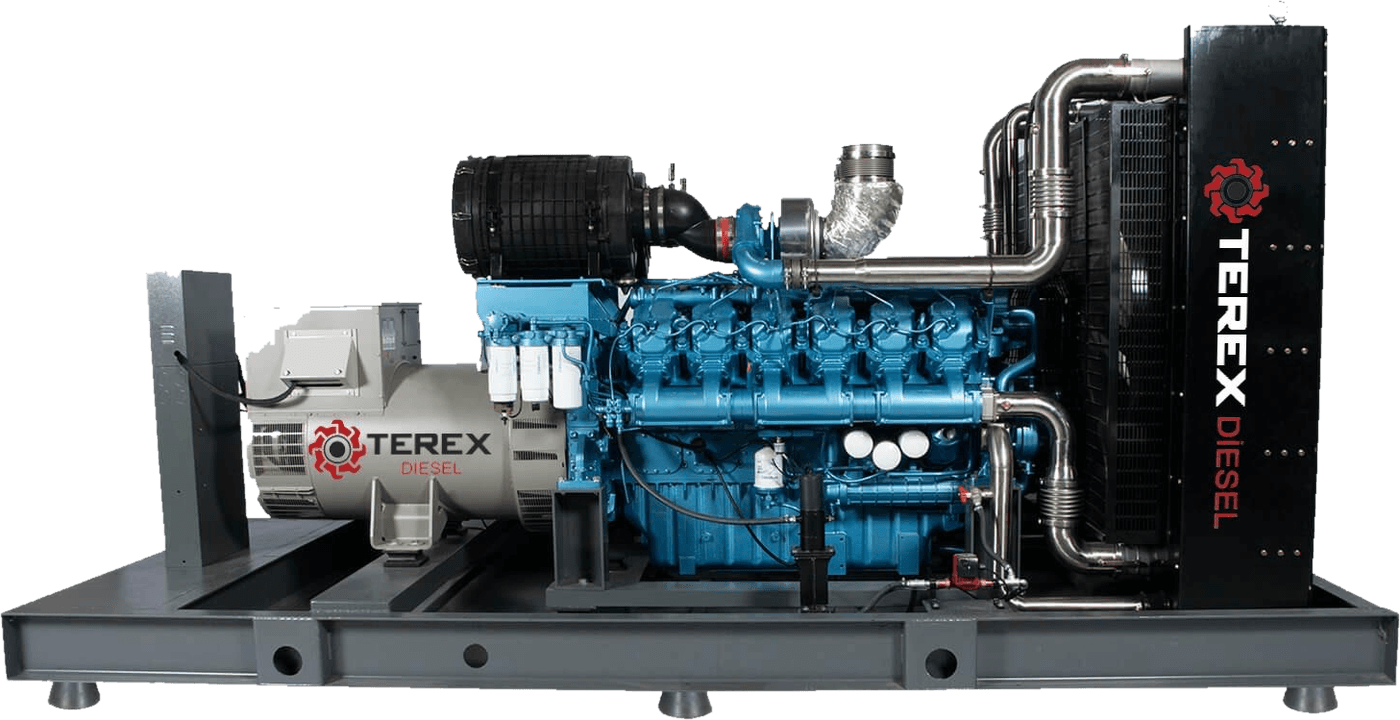
Generator Derating for Heat and Altitude
Why do generators lose power in heat and at altitude? ISO 3046 reference conditions, derating curves, alternator effects and a worked example.
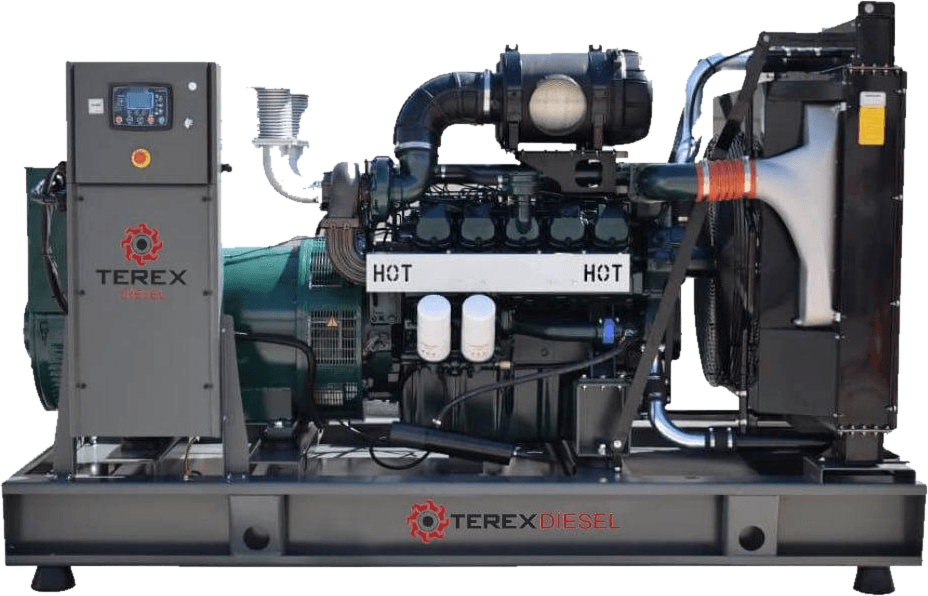
Generator Engine Brands Compared
Perkins, Cummins, Baudouin, FPT Iveco, Kofo, Kubota, Quartz, Scania, SDEC, Volvo Penta, Yangdong and Yuchai compared: origin, our power range, service network and use.