
50 Hz vs 60 Hz Generators
50 Hz vs 60 Hz generator: 1,500 vs 1,800 rpm, engine and alternator power change, 60 Hz voltages, fuel and noise effects. Don't use a fixed multiplier.
Contents
The basic difference between 50 Hz and 60 Hz generators is speed: a 4-pole alternator runs at 1,500 rpm for 50 Hz and 1,800 rpm for 60 Hz. As speed increases the set’s power generally increases, but the rate of increase depends on the engine and alternator, and in particular on the output voltage at 60 Hz. For this reason it is not correct to multiply the 50 Hz power by a fixed factor to find the 60 Hz power; the data sheets must be checked for each set.
Frequency and speed relationship
In a synchronous alternator, the relationship between frequency, speed and number of poles is:
n (rpm) = 120 × f ÷ number of poles
| Number of poles | 50 Hz | 60 Hz |
|---|---|---|
| 4-pole | 1,500 rpm | 1,800 rpm |
| 2-pole | 3,000 rpm | 3,600 rpm |
The vast majority of industrial diesel generators are 4-pole. The grid in Türkiye and Europe is 50 Hz; countries such as the USA, Canada, Mexico, Saudi Arabia and South Korea use 60 Hz. 60 Hz is also common in marine and offshore applications.
Engine side: how much does power change?
At 1,800 rpm the engine completes more cycles per minute, which means the potential to produce more power. However, manufacturers set the engine’s 60 Hz rating according to turbocharger, fuel system, emissions, cooling and mechanical limits. Some examples taken from official engine data sheets (from 50 Hz to 60 Hz, approximate):
| Engine | Change in engine power (approximate) |
|---|---|
| Volvo Penta TAD1345GE | ≈ 0–1% |
| FPT N67 TM3A | ≈ +8–9% |
| Scania DC13 072A | ≈ +10–11% |
| Cummins QSL9-G5 | ≈ +15% |
| Baudouin 6M11G4D0/S | ≈ +18% (engine side) |
The table shows that even engines in the same power class can behave very differently. Values may vary with the power rating (standby/prime) and the data sheet revision; the current data sheet always prevails.
Alternator side: voltage is decisive
The power an alternator can deliver is determined by the current the winding can carry and the output voltage. When the alternator can run at a higher voltage at 60 Hz, it delivers more kVA for the same current. For example, in the data sheet of a Stamford UCI274H alternator:
| Frequency / voltage | Power |
|---|---|
| 50 Hz, 400 V | 200 kVA |
| 60 Hz, 416 V | 237.5 kVA (≈ +19%) |
| 60 Hz, 480 V | 255 kVA (≈ +27.5%) |
If the same alternator runs at a lower voltage at 60 Hz (e.g. 380 V or 208 V), the increase is smaller or there may be none. This example, in which the alternator increase varies roughly between 19% and 27.5% depending on voltage, applies to one model only.
How is a set’s 60 Hz power determined?
The power of a generator set is limited by whichever delivers less power, the engine or the alternator:
- Take the kW value from the engine’s 60 Hz (1,800 rpm) data sheet.
- Convert it to electrical kW taking alternator efficiency into account, and to kVA with a 0.8 power factor.
- Compare it with the alternator’s kVA value at the target voltage and 60 Hz.
- The lower value becomes the set’s 60 Hz power; if necessary, a different alternator is selected.
For example, on a model where the engine side barely increases, the set’s power hardly changes even if the alternator can deliver 27.5% more power at 480 V. Conversely, on a model where the engine increases significantly, the alternator can become the bottleneck at low voltage.
Common voltages at 60 Hz
| Three-phase / phase-neutral | Typical use |
|---|---|
| 480/277 V | Industry and large commercial facilities in North America |
| 440/254 V | Some industrial and marine applications |
| 380/220 V | Some Middle Eastern and Latin American countries |
| 208/120 V | Commercial buildings in North America |
| 220/127 V | Some parts of Latin America |
The voltage is chosen according to the country’s grid standard, the site’s distribution system and the equipment to be connected.
Fuel consumption and noise
- Fuel: Because friction and fan losses increase at 1,800 rpm, consumption at the same load is generally higher than at 50 Hz. The exact value is in the engine data sheet.
- Noise: Higher engine and fan speed generally raises the noise level by a few dB. For projects with a noise limit, the 60 Hz value should be checked separately.
- Cooling: Because radiator and fan performance change with speed, cooling capacity is also verified for 60 Hz.
Common mistakes
- Estimating 60 Hz power by multiplying 50 Hz power by a fixed factor (e.g. ×1.2)
- Requesting a 60 Hz set without specifying the voltage
- Ignoring the effect of running motors and equipment designed for 50 Hz at 60 Hz (such as motors turning approximately 20% faster)
- Changing frequency without updating protection, AVR and governor settings
Next step
Terex Diesel can supply 60 Hz versions on request; power, voltage, fuel and noise values are determined for each project according to the selected engine and alternator. To send us the frequency, voltage and power you need, contact us. For a preliminary power estimate, you can use the power calculator.
Planning a generator for a project?
Send us the power, voltage and destination. We reply with a suitable model, the factory price and the lead time within 24 hours on working days.
Frequently asked questions
Can a 50 Hz generator be run at 60 Hz?
Many engines and alternators are designed for both frequencies; however, the speed setting, voltage setting and control and protection settings must be changed. The power the set will deliver at 60 Hz must be determined separately from the engine and alternator data sheets. The conversion should be carried out by a qualified technical team.
What percentage more power does a 60 Hz generator deliver than at 50 Hz?
There is no fixed ratio. In examples from official data sheets, the increase on the engine side is almost zero for some models and reaches approximately 15–18% for others. On the alternator side, the increase depends on voltage. The set's 60 Hz power is limited by whichever is lower, the engine or the alternator.
What voltages are used at 60 Hz?
Common three-phase voltages on 60 Hz grids are 480/277 V, 440/254 V, 380/220 V, 208/120 V and 220/127 V. Which voltage is used depends on the country and the type of facility; the generator should be ordered for that voltage.
Featured models
Technical data of models in frequently requested power ratings:
- 38 kVATRX QZ TA 0038Quartz Q490ZD
- 58 kVATRX QZ TA 0058Quartz Q4105D
- 77 kVATRX QZ TA 0077Quartz Q4105ZD
- 105 kVATRX QZ TA 0105Quartz Q4105AZLD
- 155 kVATRX QZ TA 0155Quartz Q6105AZLD
- 260 kVATRX SD TA 0260SDEC SC9D310D2
- 300 kVATRX SD TA 0300SDEC SC9D340D2
- 400 kVATRX SD TA 0400SDEC SC15G500D2
- 520 kVATRX SD TA 0520SDEC SC25G610D2
Related articles
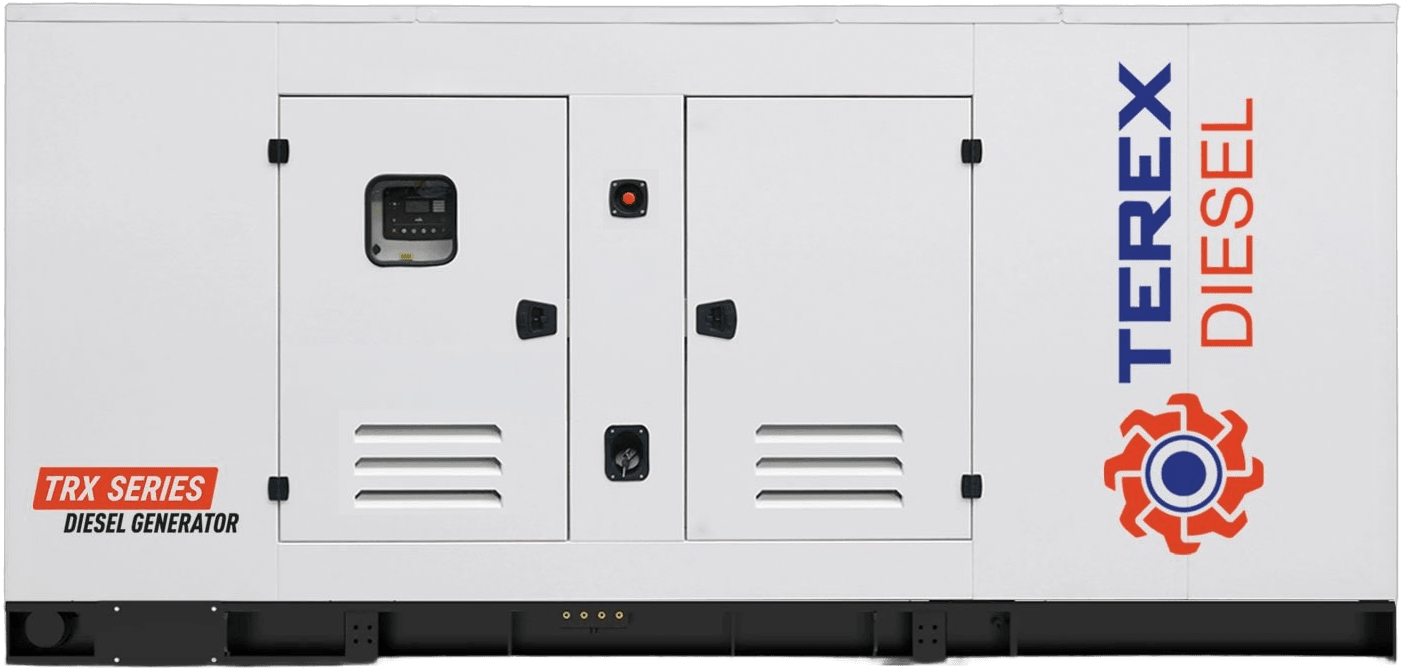
What Size Generator Do I Need?
Add running loads and the largest motor start (DOL ×3, star-delta ×2, soft starter ×1.5), add 20%, then kVA = kW ÷ 0.8. Worked example included.
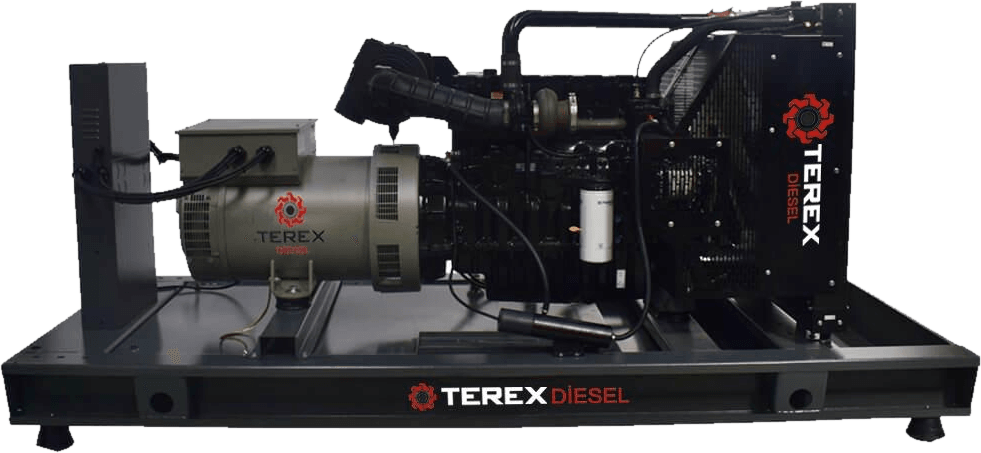
Standby vs Prime vs Continuous Power
Standby: outages only, ≤200 h/year, no overload. Prime: unlimited hours at variable load, typically 10% overload 1 h in 12. Continuous: constant load.
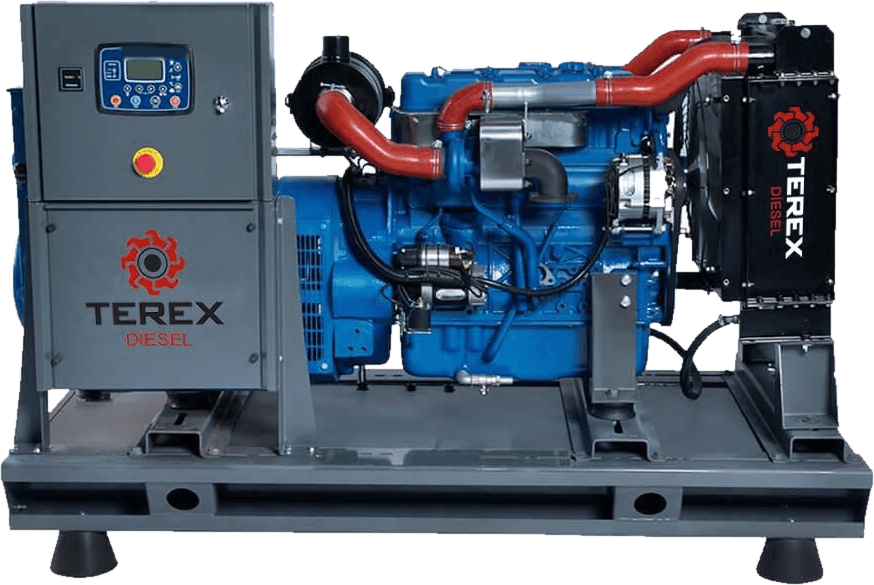
Single-Phase or Three-Phase?
Single phase vs three phase generator: choosing by phase, voltage and current, unbalanced loads and supplying single-phase loads from a 3-phase set.

Choosing a Silent (Canopied) Generator
How to choose a silent generator: dB(A) at 7 metres, sound power vs sound pressure, soundproof canopy design, silencers and the right placement.
Generator Derating for Heat and Altitude
Why do generators lose power in heat and at altitude? ISO 3046 reference conditions, derating curves, alternator effects and a worked example.
Generator Engine Brands Compared
Perkins, Cummins, Baudouin, FPT Iveco, Kofo, Kubota, Quartz, Scania, SDEC, Volvo Penta, Yangdong and Yuchai compared: origin, our power range, service network and use.