
Generator Synchronization Panel
Generator synchronization panel for running gensets in parallel with each other or the grid: load sharing, AMF/ATS, controllers, custom build.
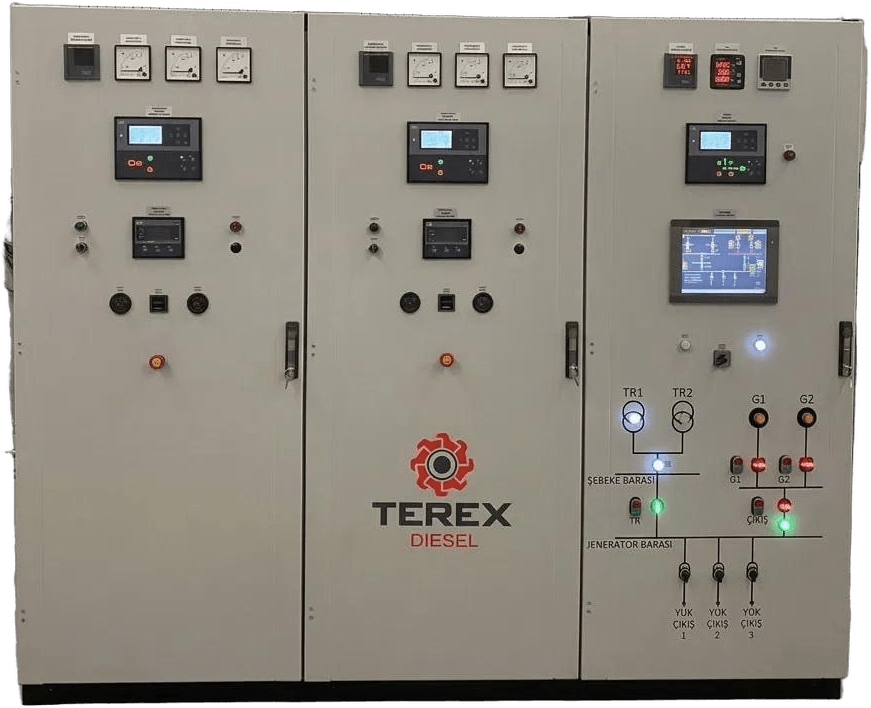
A generator synchronization panel is the control and power panel that allows several generators to run in parallel with each other or with the grid. The panel matches the voltage, frequency and phase angle of the generators, connects the sets to a common busbar and shares the total load between them. Instead of one large generator, several sets that come online and go offline as required supply the same site.
We design synchronization panels for each project, manufacture them at our facility in Türkiye, and test and commission them together with the generator sets.
How does a synchronization panel work?
The controller of each generator to be paralleled continuously measures the busbar voltage and frequency. When a generator is to be brought online, the following steps take place:
- Start and run-up: The generator starts and reaches rated speed and voltage.
- Matching: The controller adjusts engine speed and alternator voltage so that the generator’s voltage, frequency and phase angle match the busbar. Phase sequence is also checked.
- Breaker closing: As soon as the values are within the permitted limits, the generator breaker closes and the set is connected to the busbar.
- Load sharing: The connected sets share active power (kW) and reactive power (kVAr) in proportion to their ratings.
- Load management: When the load rises, the next generator comes online automatically; when the load falls, a set that is no longer needed transfers its load, goes offline and stops after its cool-down period.
These operations run without operator intervention, through communication between the controllers. You can find the technical details of parallel operation in our article on generator synchronization and paralleling.
Operating modes: AMF, ATS and synchronization
| Operating mode | What it does | Typical use |
|---|---|---|
| AMF (automatic mains failure) | Starts a single generator when the mains fails and stops it when the mains returns | Single-generator standby power |
| ATS transfer panel | Transfers the load between the grid and the generator; the two are never connected to the load at the same time | Standby power for buildings and facilities |
| Generator-to-generator synchronization | Connects several sets to a common busbar and shares the load | High power, redundancy, variable load |
| Parallel operation with the grid | Connects the generator to the same busbar as the grid; no-break return or base-load generation | Industry, cogeneration, peak load management |
In single-generator applications, the control panel on the set and an ATS transfer panel are sufficient for mains monitoring and automatic start. A synchronization panel is used when several sets will run together or when the generator must run in parallel with the grid.
Standard control panel and synchronization controllers
On Terex Diesel generator sets, the standard control panel is determined by the power in the model code:
- Sets below 500 kVA: Datakom DKG-309
- Sets of 500 kVA and above: Datakom D-500
These controllers handle mains monitoring, automatic start and engine protection for a single set. Synchronized systems use one of the synchronization controllers in our product catalogue:
- Datakom: D500 MK2, D700
- Deep Sea: 8610, 8620, 8660
- ComAp: InteliCompact NT SPtM, InteliGen BaseBox, InteliGen 200
The controller is chosen according to the number of sets, the need for parallel operation with the grid, and the communication requirements for remote monitoring and automation systems. A feature comparison of all controllers is on our generator controllers page.
What is inside the panel?
Each synchronization panel is configured for its project. A typical panel includes:
- A motorised breaker and a synchronization controller for each generator
- A common busbar and, where required, a mains breaker
- Current and voltage transformers, metering and protection relays
- Load sharing and set priority sequencing (automatic rotation that balances running hours)
- Emergency stop, alarm and warning signals
- Remote monitoring connection (GSM, Ethernet or building management system)
The enclosure, breaker ratings and protection settings are selected according to the site’s short-circuit level and total power.
Why several generators?
- Redundancy: When one set fails or is under maintenance, the others continue to supply critical loads.
- Efficient operation at low load: When the load drops, a single set runs; problems caused by running a large generator at low load for long periods are avoided and fuel consumption is reduced.
- Phased expansion: When the site’s power demand grows, new sets can be added to the existing system.
- Easier maintenance: Running hours are shared between the sets, which makes maintenance planning easier.
For projects that require two synchronized sets on a single base frame, we also offer dual generator sets, for example 2 × 1000 kVA on one base frame for a 2000 kVA requirement.
Where is it used?
Synchronization panels are used in projects with high or variable power demand that cannot tolerate interruptions:
- Data centres and telecoms infrastructure
- Hospitals and healthcare campuses
- Industrial plants and organised industrial zones
- Shopping centres, hotels and large commercial buildings
- Mining sites and off-grid projects
- Cogeneration and medium voltage systems
Power ranges
The sets used in synchronized systems are selected from the diesel generators in our product catalogue, covering 10–4,125 kVA. For ratings frequently chosen in high-power projects, see our 500 kVA, 1000 kVA, 1500 kVA and 2000 kVA generator pages. Sets up to 1,100 kVA are supplied with a soundproof canopy, and larger sets as containerised generators.
Custom manufacturing and commissioning
A synchronization project starts with a clear definition of the requirement. The following information helps us prepare a quotation:
- Total power demand and the number of sets
- Whether parallel operation with the grid is required, or only the generators will be synchronized
- Voltage and frequency (50 Hz or 60 Hz)
- Make, model and controller details of any existing sets
- Requirements for remote monitoring or building management integration
Panel manufacturing, on-site installation, cabling, automation integration, testing and commissioning are carried out by our own teams. To add synchronization to existing generators, see our ATS and synchronization retrofit service; for installation, see installation and commissioning. Request a quote for your project or talk to our service team.
Frequently asked questions
What does a generator synchronization panel do?
A synchronization panel allows several generators to run in parallel with each other or with the grid at the same voltage, frequency and phase angle. The generators are connected to a common busbar, share the load and are started or stopped automatically according to demand.
What is the difference between a synchronization panel and an ATS panel?
An ATS panel transfers the load to a single generator when the mains fails; the generator and the grid are never connected to the load at the same time. A synchronization panel connects generators in parallel with each other or with the grid and shares the load between them. Synchronization panels are used in multi-generator projects, while an ATS is used for single-generator standby power.
What is the standard control panel on the generators?
On Terex Diesel generator sets, the standard control panel is the Datakom DKG-309 when the power in the model code is below 500 kVA, and the Datakom D-500 at 500 kVA and above. These controllers handle mains monitoring and automatic start (AMF) for a single set. Synchronized systems use separate controllers designed for synchronization.
Which controllers are used in the synchronization panel?
The synchronization controllers in our product catalogue are the Datakom D500 MK2 and D700, Deep Sea 8610, 8620 and 8660, and ComAp InteliCompact NT SPtM, InteliGen BaseBox and InteliGen 200. The choice depends on the number of sets, the need for parallel operation with the grid and the automation requirements of the project.
Can generators of different ratings be synchronized?
Yes. Generators of different ratings with the same voltage and frequency, fitted with a suitable controller and voltage regulator, can be connected to the same busbar. The controllers share the load in proportion to the rating of each set. Suitability is assessed at the design stage based on the engine, alternator and regulator data of the sets.
Can synchronization be added to existing generators?
In most cases, yes. The controller, engine speed control and voltage regulator of the existing sets are inspected, and a synchronization controller and panel are added to suitable sets. For this work, see our ATS and synchronization retrofit service.