
Choosing a Silent (Canopied) Generator
How to choose a silent generator: dB(A) at 7 metres, sound power vs sound pressure, soundproof canopy design, silencers and the right placement.

Contents
When choosing a silent (canopied) generator, three things matter: at what distance and under what conditions the noise level in the data sheet was measured, how the canopy is designed and where the set will be placed on site. The dB(A) value in the catalogue is usually given at 7 metres; in a real environment, however, the sound you hear varies considerably with position, reflective surfaces and distance.
Reading the dB(A) value correctly
There are two different quantities related to generator noise:
- Sound pressure level (Lp): The value perceived by the ear, measured at a given distance. Catalogues commonly give it at 7 metres, in dB(A).
- Sound power level (LwA): The total acoustic energy emitted by the source; it is independent of distance. In Europe, regulations require this value to be shown on the label for generators of certain power classes used outdoors.
The two values should not be confused. 95 dB(A) LwA and 70 dB(A) at 7 metres may be two separate pieces of information for the same set. When comparing, check:
- Measurement distance (1 m, 7 m, 10 m?)
- Load condition (no load, 75% load or full load?)
- Measurement environment (free field?)
- Whether the value is an average or the highest point
What you need to know about decibels
The decibel is a logarithmic scale, so our intuition is often misleading:
- Each time the distance doubles, sound pressure falls by approximately 6 dB in open field.
- When two sources at the same level run side by side, the total level rises by approximately 3 dB.
- A difference of approximately 10 dB is perceived by the ear as roughly twice as loud or quiet.
| Distance | Set at 70 dB(A) at 7 m (approximate, open field) |
|---|---|
| 7 m | 70 dB(A) |
| 14 m | 64 dB(A) |
| 28 m | 58 dB(A) |
| 56 m | 52 dB(A) |
This table is an idealised calculation; building façades, the ground and background noise change the result.
What should a good canopy have?
Silence is not achieved just with a thick sheet-metal box. The following elements matter in canopy design:
- Sound-absorbing insulation: Materials such as rock wool or acoustic foam on the inner surfaces, with an oil- and fuel-resistant facing.
- Air inlet and outlet attenuators (baffles): The engine and radiator need a large volume of air. Sound-attenuating labyrinths in the air ducts let the air through while blocking the noise.
- Exhaust silencer: Industrial, residential or critical-grade silencers provide different levels of attenuation. In residential areas, a silencer with higher attenuation is preferred.
- Vibration isolation: Mounting the engine and alternator to the base frame on anti-vibration mounts reduces structure-borne noise.
- Cooling capacity: If the temperature inside the canopy rises, the set may have to derate. It should be checked that the canopied set can deliver full power at the stated ambient temperature.
- Durability: Galvanised or suitably pre-treated sheet metal, outdoor-grade paint, sealed door gaskets and lockable doors.
- Service access: Wide doors giving easy access to oil, filters, battery and control panel determine how easy a canopied set is to maintain.
- Transport and lifting: Lifting points, forklift pockets and, where required, a fuel tank integrated into the base frame.
Placement: half the noise is in the layout
The same set is perceived as much quieter when it is placed correctly:
- Distance: Place the set as far as possible from sensitive areas such as bedrooms, offices and patient rooms.
- Direction: Point the exhaust and radiator air outlet away from sensitive areas.
- Reflective surfaces: Squeezing the set into a corner formed by two walls can raise the noise level through reflection.
- Ground: A flat, solid concrete plinth reduces vibration transmission.
- Barriers: An acoustic screen wall can be used if needed, but it must not restrict the cooling airflow.
- Regulations: Limit values set by municipalities and environmental noise regulations should be checked at the design stage, especially for night-time operation.
Canopy or generator room?
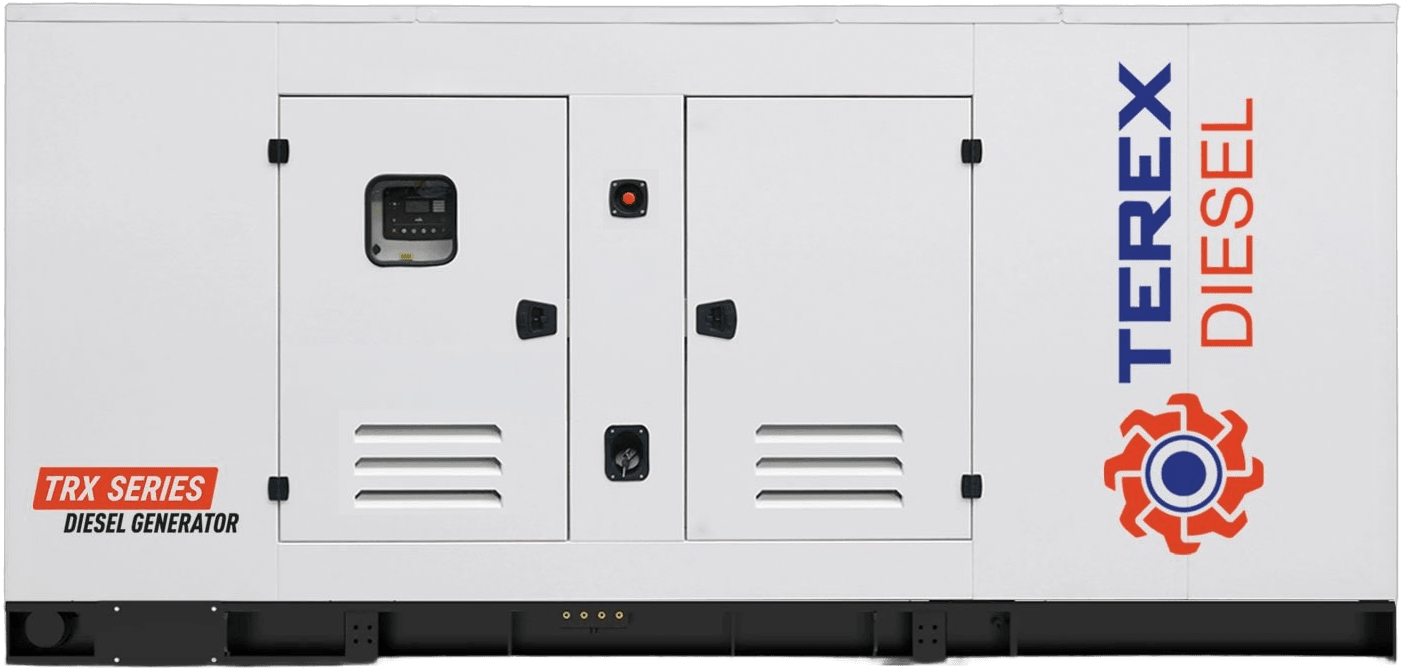
- Canopied set: Installed outdoors, needs no separate room, is transportable and quick to commission. Common for construction sites, residential complexes, homes, commercial buildings and rental.
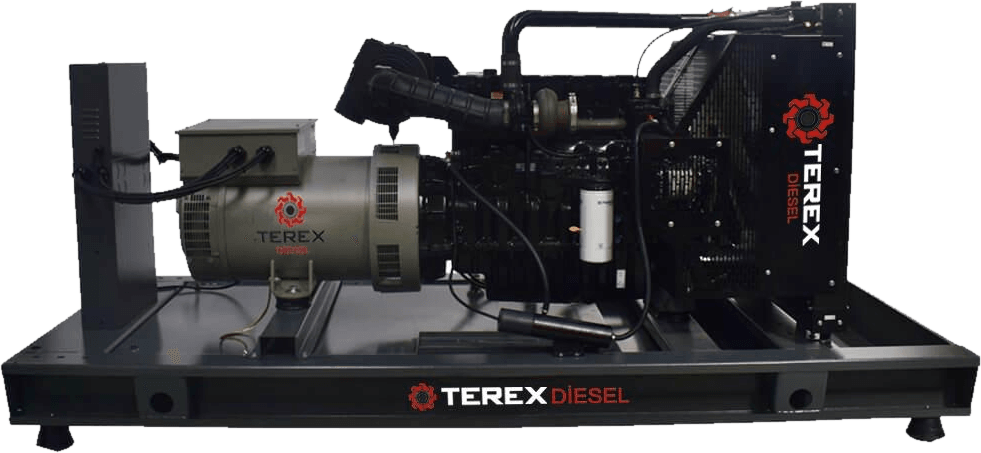
- Open-type set and generator room: Preferred for large power ratings or where space has been allocated inside the building. Sound insulation is provided by the room’s acoustic design; ventilation and exhaust are designed separately.
Short selection list
- Is the target noise level at the installation site and the measurement point defined?
- Are the measurement distance and load condition of the data sheet value known?
- Can the canopy deliver full power at the highest ambient temperature on site?
- Can the exhaust and air outlet be directed away from sensitive areas?
- Has enough clearance been left for service doors and refuelling?
Next step
See our generator canopy page for canopy options and design details; find the required power with the power calculator and list suitable models with the generator finder. Model-specific noise values are given in the technical tables on the product pages; for projects with a target noise level, contact us.
Planning a generator for a project?
Send us the power, voltage and destination. We reply with a suitable model, the factory price and the lead time within 24 hours on working days.
Frequently asked questions
Why is generator noise measured at 7 metres?
Generator catalogues commonly give the sound pressure level at a distance of 7 metres around the set, in open field, in dB(A). This common convention makes it easier to compare different manufacturers' values; even so, the measurement method and load condition should always be checked in the data sheet.
How much does generator noise decrease with distance?
In open field, assuming a point source, the sound pressure level falls by approximately 6 dB each time the distance doubles. For example, a set measured at 70 dB(A) at 7 metres will be approximately 64 dB(A) at 14 metres and approximately 58 dB(A) at 28 metres. Walls and reflective surfaces can increase this value.
What is the difference between a silent generator and an open-type generator?
A silent generator is a set in which the engine and alternator are housed in a soundproof canopy. The canopy reduces noise with insulation material, sound-attenuating air ducts and a more effective exhaust silencer, and also protects the set from the weather. An open-type set is usually installed in a separate generator room.
Featured models
Technical data of models in frequently requested power ratings:
- 38 kVATRX QZ TA 0038Quartz Q490ZD
- 58 kVATRX QZ TA 0058Quartz Q4105D
- 77 kVATRX QZ TA 0077Quartz Q4105ZD
- 105 kVATRX QZ TA 0105Quartz Q4105AZLD
- 155 kVATRX QZ TA 0155Quartz Q6105AZLD
- 260 kVATRX SD TA 0260SDEC SC9D310D2
- 300 kVATRX SD TA 0300SDEC SC9D340D2
- 400 kVATRX SD TA 0400SDEC SC15G500D2
- 520 kVATRX SD TA 0520SDEC SC25G610D2
Related articles
What Size Generator Do I Need?
Add running loads and the largest motor start (DOL ×3, star-delta ×2, soft starter ×1.5), add 20%, then kVA = kW ÷ 0.8. Worked example included.
Standby vs Prime vs Continuous Power
Standby: outages only, ≤200 h/year, no overload. Prime: unlimited hours at variable load, typically 10% overload 1 h in 12. Continuous: constant load.
Single-Phase or Three-Phase?
Single phase vs three phase generator: choosing by phase, voltage and current, unbalanced loads and supplying single-phase loads from a 3-phase set.
50 Hz vs 60 Hz Generators
50 Hz vs 60 Hz generator: 1,500 vs 1,800 rpm, engine and alternator power change, 60 Hz voltages, fuel and noise effects. Don't use a fixed multiplier.
Generator Derating for Heat and Altitude
Why do generators lose power in heat and at altitude? ISO 3046 reference conditions, derating curves, alternator effects and a worked example.
Generator Engine Brands Compared
Perkins, Cummins, Baudouin, FPT Iveco, Kofo, Kubota, Quartz, Scania, SDEC, Volvo Penta, Yangdong and Yuchai compared: origin, our power range, service network and use.