
Canopied or Open-Type Generator?
Canopied (silent) or open-type generator? Choosing the enclosure by installation site, noise, weather, maintenance access, ventilation and power.
Contents
In a diesel generator the engine, alternator and control panel are the same whichever enclosure you choose; what changes is the housing around them. The enclosure decides where the set can be installed, how much noise it makes around it, how maintenance is done and whether extra building work is needed.
The two enclosure types in brief
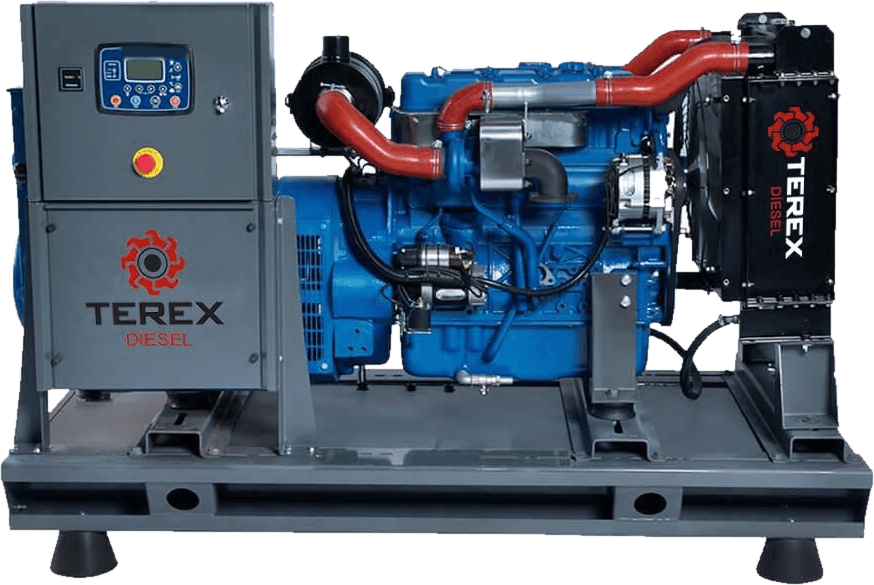
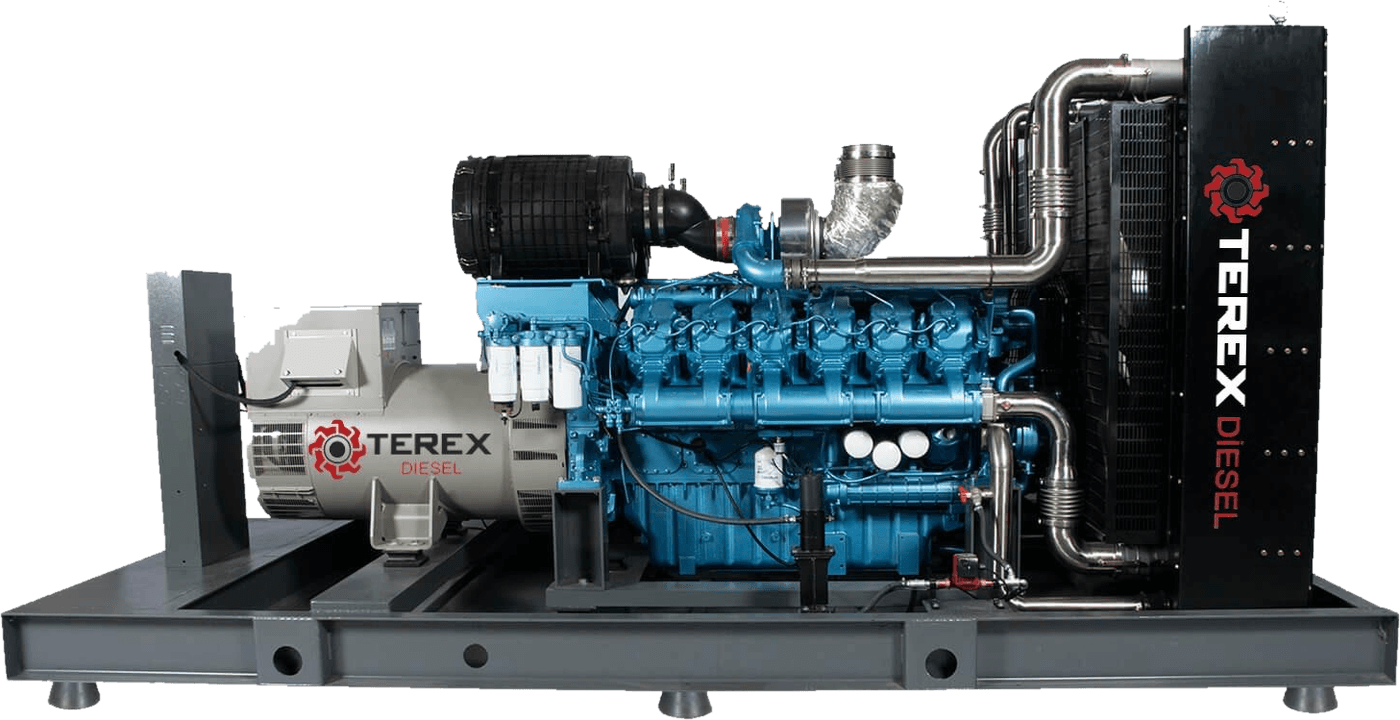
Open-type generator: engine, alternator, radiator and control panel are mounted on a common base frame. The set is uncovered and has no protection against rain, dust or impact. It is designed for a closed generator room or another sheltered area.
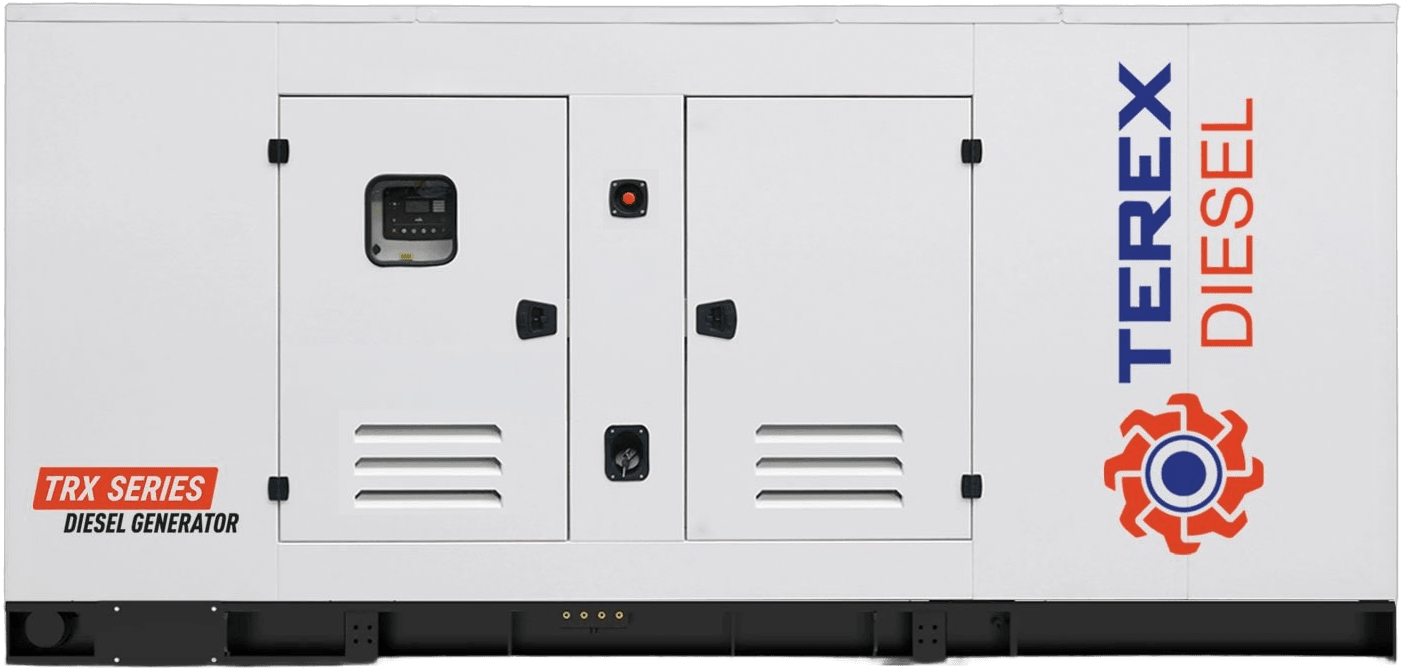
Canopied (silent) generator: the same set is inside a steel canopy lined with sound insulation, with lockable doors. The canopy guides the air inlet and outlet and houses the silencer and the exhaust outlet. It can be installed directly outdoors.
At high outputs there is a third option, the containerised generator. In our range, canopied or open-type versions are offered up to 1,100 kVA, and containerised or open-type versions above 1,100 kVA.
Side-by-side comparison
| Criterion | Canopied (silent) | Open type |
|---|---|---|
| Installation site | Outdoors, roof, car park, yard | Generator room, closed and sheltered area |
| Noise | Reduced by canopy insulation and internal silencer | Depends on the insulation of the room |
| Weather protection | Provided by the canopy | Provided by the building or room |
| Unauthorised access | Lockable doors | Door and lock of the room |
| Ventilation and exhaust | Solved inside the canopy | Designed separately for the room |
| Maintenance access | Through the doors; space limited by the canopy | Free working space around the set |
| Footprint | The canopy dimensions | Set plus maintenance clearances in the room |
| Relocation | Easy to move | Suited to fixed installation |
The data table further down shows what the canopy adds in size and weight for three models from our own data sheets.
When is a canopied set the right choice?
- There is no generator room, or building one would need extra construction, ventilation ducts and an exhaust line.
- There is a noise limit, as in residential areas, hospitals, hotels and offices. To read the noise value correctly, see choosing a silent generator.
- The set will stand in the open, on a construction site, farm, telecom station or car park.
- It may be moved later. If it is moved often, consider a trailer-mounted generator.
When is an open-type set the right choice?
- A suitable generator room exists, with ventilation, exhaust line and concrete plinth ready. See generator room and installation.
- Maintenance access comes first: free working space on all four sides makes servicing and overhauls easier.
- High output and fixed installation: large sets usually go into dedicated rooms or containers.
- The project needs its own enclosure, designed later around the set.
Common mistakes
- Installing an open set outdoors under a simple roof. The control panel and alternator windings suffer from moisture.
- Not calculating room ventilation. Radiator air and engine heat must leave the room, otherwise the set stops on high temperature or loses power.
- Placing a canopied set against a wall. Without clearance at the air inlet and outlet, hot air is drawn back in, and the doors cannot be opened for maintenance.
- Comparing only the purchase price. The open set uses less material, but the room, its insulation, ventilation and exhaust are part of the total investment.
Next step
All our canopied and open-type sets are built at our facility in Tuzla, Istanbul and load-tested before shipment. For canopy construction see generator canopies. Tell us the installation site and the power you need, and we will prepare a written offer with the right enclosure: contact us.
Open type and canopied: size and weight (from our data sheets)
| Model | Open type: Dimensions (L × W × H) | Open type: Weight | Canopied (soundproof): Dimensions (L × W × H) | Canopied (soundproof): Weight | Fuel tank |
|---|---|---|---|---|---|
| TRX P ST 0110 | 2200 × 1000 × 1385 | 1,127 kg | 2600 × 1000 × 1570 | 1,352 kg | 139 L |
| TRX P ST 0250 | 2850 × 1200 × 1920 | 1,877 kg | 3600 × 1200 × 2288 | 2,269 kg | 415 L |
| TRX P ST 0500 | 3600 × 1500 × 2116 | 3,487 kg | 4050 × 1600 × 2615 | 4,141 kg | 819 L |
Planning a generator for a project?
Send us the power, voltage and destination. We reply with a suitable model, the factory price and the lead time within 24 hours on working days.
Get factory priceAsk on WhatsApp
We reply in English.
Frequently asked questions
What is the difference between a canopied and an open-type generator?
In an open-type set the engine, alternator and control panel sit uncovered on a base frame; it is designed to be installed in a closed generator room. In a canopied set the same equipment is inside a lockable, sound-insulated steel canopy; it can be installed outdoors and runs more quietly.
Can an open-type generator be installed outdoors?
It is not recommended, because an open set is not protected against rain, dust or unauthorised access. For outdoor use, choose a canopied model or place the set in a generator room or container with designed ventilation and exhaust.
At which outputs are canopied and open-type versions available?
In the Terex Diesel range, sound-insulated canopied or open-type versions are offered up to 1,100 kVA, and containerised or open-type versions above 1,100 kVA. We confirm the options for each model at the quotation stage.
Featured models
Technical data of models in frequently requested power ratings:
- 38 kVATRX QZ TA 0038Quartz Q490ZD
- 58 kVATRX QZ TA 0058Quartz Q4105D
- 77 kVATRX QZ TA 0077Quartz Q4105ZD
- 105 kVATRX QZ TA 0105Quartz Q4105AZLD
- 155 kVATRX QZ TA 0155Quartz Q6105AZLD
- 260 kVATRX SD TA 0260SDEC SC9D310D2
- 300 kVATRX SD TA 0300SDEC SC9D340D2
- 400 kVATRX SD TA 0400SDEC SC15G500D2
- 520 kVATRX SD TA 0520SDEC SC25G610D2
Related articles
What Size Generator Do I Need?
Add running loads and the largest motor start (DOL ×3, star-delta ×2, soft starter ×1.5), add 20%, then kVA = kW ÷ 0.8. Worked example included.
Standby vs Prime vs Continuous Power
Standby: outages only, ≤200 h/year, no overload. Prime: unlimited hours at variable load, typically 10% overload 1 h in 12. Continuous: constant load.
Single-Phase or Three-Phase?
Single phase vs three phase generator: choosing by phase, voltage and current, unbalanced loads and supplying single-phase loads from a 3-phase set.

Choosing a Silent (Canopied) Generator
How to choose a silent generator: dB(A) at 7 metres, sound power vs sound pressure, soundproof canopy design, silencers and the right placement.
50 Hz vs 60 Hz Generators
50 Hz vs 60 Hz generator: 1,500 vs 1,800 rpm, engine and alternator power change, 60 Hz voltages, fuel and noise effects. Don't use a fixed multiplier.
Generator Derating for Heat and Altitude
Why do generators lose power in heat and at altitude? ISO 3046 reference conditions, derating curves, alternator effects and a worked example.